
Modernizing Legacy ERP Systems for the Cloud Era
A risk-managed roadmap for opening, decomposing, and evolving mission-critical ERP capabilities without disrupting business continuity.
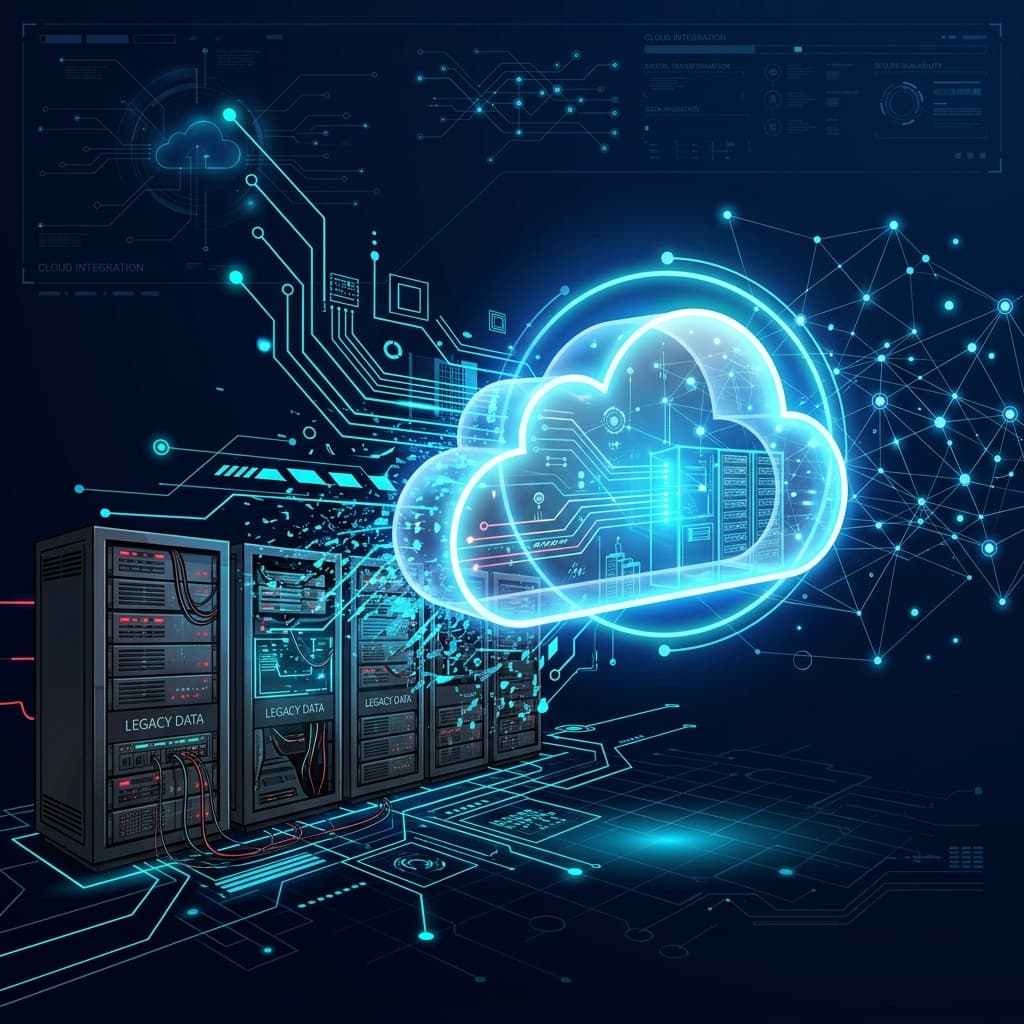
Legacy ERP platforms often carry decades of business knowledge: financial controls, pricing rules, production planning, inventory valuation, tax treatment, and operational exceptions. Their age may create cost and delivery constraints, but replacing them as if they were ordinary applications can put the enterprise's system of record at risk.
Modernization should therefore be framed as a controlled transfer of capabilities, data ownership, and operational responsibility. The goal is not “move the monolith to the cloud.” It is to improve change velocity, resilience, integration, security, and user experience while preserving transaction integrity and business continuity.
Diagnose Before Choosing a Strategy
Create a fact-based baseline covering application dependencies, customizations, batch jobs, interfaces, data quality, infrastructure, licenses, skills, incident history, performance, recovery, and audit controls. Map critical business journeys such as order-to-cash, procure-to-pay, plan-to-produce, record-to-report, and hire-to-retire.
Classify components using a portfolio of treatments:
- Retain: stable capability with acceptable risk and cost.
- Rehost: move infrastructure with minimal application change.
- Replatform: adopt managed database, runtime, or operations while preserving behavior.
- Refactor: redesign a constrained capability to improve maintainability or scale.
- Replace: adopt a modern product when differentiation is low and migration is justified.
- Retire: remove unused reports, integrations, data, and customizations.
Modernize by business capability
Sequence work around bounded business outcomes, not technical layers alone. Moving every database first or rewriting every screen creates long programs with little usable value and difficult rollback.
Use the Strangler Pattern to Reduce Risk
Place a governed integration and experience layer around the legacy core. New channels call stable APIs rather than direct tables. BrainConnect adapters translate legacy protocols and publish approved domain events. New services gradually take ownership of selected capabilities while remaining processes continue in the ERP.
[Diagram placeholder: Strangler modernization architecture]

Web | Mobile | Partner | Analytics | AI
                  |
         API gateway + identity
                  |
      BrainConnect integration layer
         /         |          \
 Legacy ERP   New domain services   Event platform
     |              |                   |
 System of record   New ownership   CRM / AI / data platform
The façade is not merely a proxy. It enforces authentication, authorization, throttling, schema validation, observability, and versioning. It prevents every new consumer from creating another permanent dependency on legacy internals.
Protect the Transactional Core
Direct read access from portals, analytics, and integrations can introduce locks, uncontrolled load, security exposure, and tight schema coupling. Prefer supported application APIs for commands. For reporting and downstream synchronization, use a replica, change-data capture (CDC), an application outbox, or scheduled export according to platform capability and consistency needs.
CDC reproduces changes; it does not automatically reproduce business meaning. Convert low-level database changes into governed domain events only after validating transaction boundaries, ordering, reference data, deletions, and replay behavior.
interface EnterpriseDomainEvent<TPayload> {
  eventId: string;
  eventType: string;
  aggregateId: string;
  occurredAt: string;
  sourceVersion: string;
  correlationId: string;
  payload: TPayload;
}
Avoid exposing raw legacy table names as the long-term enterprise contract. Define canonical concepts such as customer, sales order, inventory movement, invoice, and payment with clear ownership and versioning.
Modernize Data Deliberately
Data migration is a business transformation workstream. Profile duplicates, missing references, invalid states, obsolete codes, retention obligations, and reconciliation rules. Decide what to migrate, archive, aggregate, or leave accessible through a read-only legacy service.
Use repeated migration rehearsals. Measure extract, transform, load, validation, and cutover duration with production-scale volumes. Reconcile control totals—general ledger, subledgers, inventory valuation, open orders, receivables, payables—not only row counts.
During coexistence, identify one authoritative writer for each entity. Bidirectional synchronization is expensive and conflict-prone; use it only for bounded transition windows with explicit rules and monitoring.
Do not confuse replication with reconciliation
A pipeline can copy every record and still preserve incorrect balances or business states. Finance and operations must approve semantic reconciliation and cutover tolerances.
Choose Cloud Architecture Based on Operating Needs
Cloud adoption can provide managed resilience, elastic integration, improved observability, and faster environment provisioning. It does not remove the need for architecture. Select regions, network topology, identity, encryption, key ownership, backup, disaster recovery, monitoring, cost controls, and data residency intentionally.
Containerizing an ERP without changing dependencies may improve deployment consistency but will not automatically improve modularity. Similarly, replacing synchronous calls with a message broker does not make a system event-driven unless ownership, failure handling, idempotency, and eventual consistency are designed.
Separate transactional workloads from search, analytics, document intelligence, and AI. Publish approved events into specialized platforms rather than running expensive queries against the ERP database.
Security and Control Modernization
Legacy technical accounts and broad database permissions should not be carried forward. Introduce centralized identity, workload identities, least privilege, secrets rotation, network segmentation, encryption, API authorization, audit trails, and time-bound administrative access.
Map existing segregation-of-duties controls into new services and integrations. A modern API must not let one role create and approve the same payment merely because the old ERP enforced that rule internally. Preserve evidence across the end-to-end process.
Delivery Waves
1. Establish the foundation
Create governance, architecture principles, business capability maps, observability, identity, integration standards, environments, and automated delivery controls.
2. Decouple consumption
Move reporting, portals, mobile experiences, and partner access behind supported APIs and read models. Reduce direct database connections.
3. Extract bounded capabilities
Select domains with clear ownership and manageable dependencies—for example document capture, supplier collaboration, pricing inquiry, or service scheduling. Use contract tests and parallel validation.
4. Transform core processes
Modernize complex transactional areas only after the platform and organization have demonstrated safe coexistence, migration, and recovery.
5. Retire deliberately
Remove obsolete interfaces, infrastructure, licenses, data copies, and operational procedures. Modernization value is incomplete while the old cost and risk remain.
Illustrative modernization sequencing priority
This sequence is illustrative. Portfolio priorities should reflect business urgency, regulatory commitments, dependency risk, and the organization's delivery capacity.
Measure What Changes
Track lead time for change, deployment frequency, failure rate, recovery time, batch duration, API reliability, reconciliation exceptions, security findings, infrastructure cost, manual effort, and user journey completion. Link each modernization increment to a baseline and accountable benefit owner.
Technical delivery alone does not realize value. Update roles, support models, controls, training, vendor agreements, and process ownership as capabilities move.
Executive Checklist
- Are critical business journeys and controls documented end to end?
- Does each capability have a chosen treatment and measurable outcome?
- Are new consumers prevented from coupling to legacy tables?
- Is data ownership explicit during coexistence?
- Have full-volume migration and financial reconciliation been rehearsed?
- Can every release and cutover be rolled back safely?
- Are legacy costs and interfaces scheduled for retirement?
Conclusion
Successful ERP modernization preserves what is valuable while systematically removing constraints. It uses stable contracts, event-driven integration, governed data migration, cloud operations, and incremental capability ownership to create value without betting the enterprise on a single cutover.
Brainzon brings together BrainERP for modern enterprise operations, BrainConnect for legacy and cloud integration, BrainAI for governed intelligence, and BrainCRM for connected customer processes. This platform approach provides a practical path from tightly coupled ERP estates to adaptable, cloud-first digital operations.
Recommended Related Insights
Architecting Multi-Tenant SaaS Databases for Global Scale
A practical architecture guide to building secure, scalable, and globally distributed data platforms for enterprise SaaS operations.
Optimizing ERP Procurement Workflows with Real-Time Automation
How to connect demand, inventory, suppliers, controls, and intelligent forecasting to build a faster and more resilient source-to-pay operation.