
Building a Resilient Omnichannel Retail Platform
How to unify inventory, orders, customers, stores, warehouses, and fulfillment partners without sacrificing consistency or resilience.
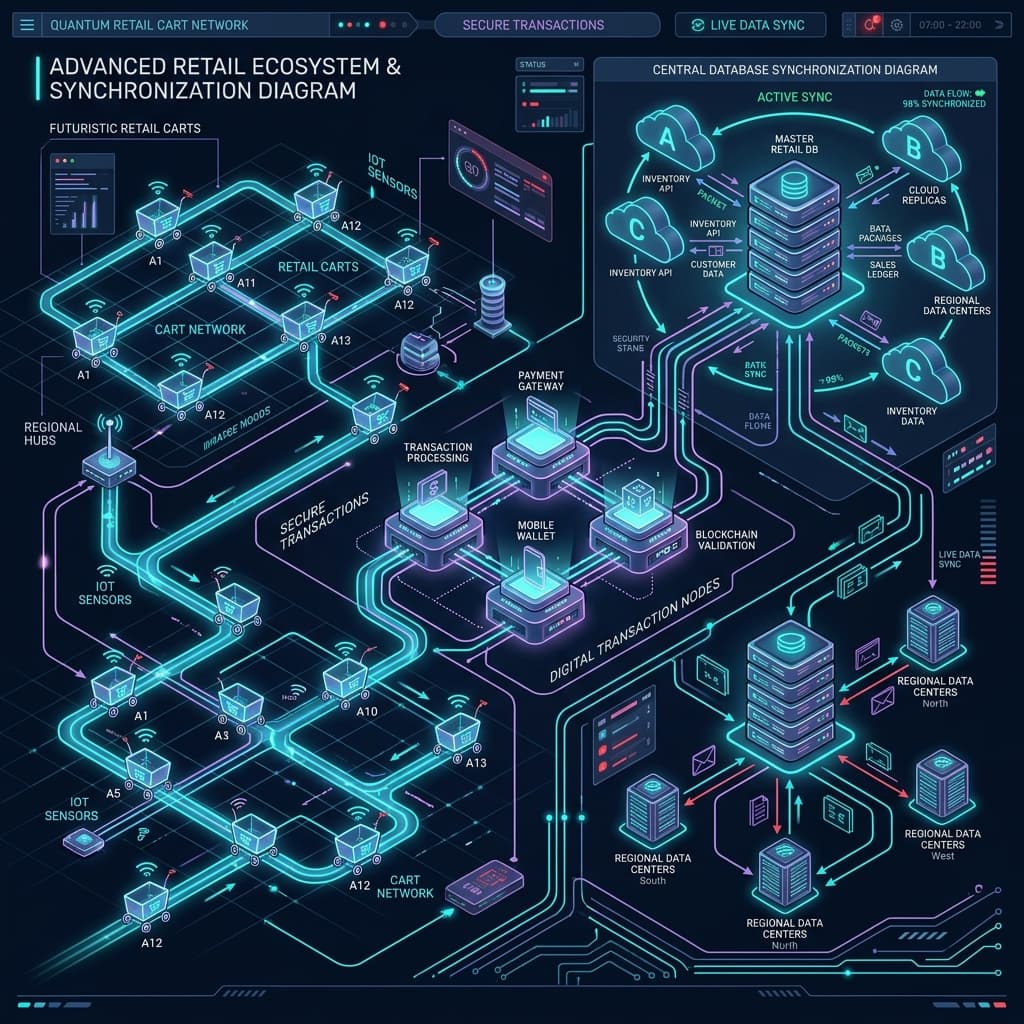
Omnichannel retail is a distributed-systems challenge expressed through a customer promise. When a shopper sees an item as available, chooses pickup or delivery, pays, and receives confirmation, multiple systems have jointly asserted that the promise can be fulfilled.
Inventory records, point-of-sale terminals, ecommerce, order management, warehouses, transportation partners, ERP, CRM, and marketplaces rarely operate on one database. A resilient platform therefore does not chase the illusion of instantaneous global consistency. It defines authoritative ownership, explicit consistency rules, recoverable workflows, and transparent customer outcomes.
Inventory Accuracy Is More Than Quantity on Hand
The number customers need is available to promise (ATP), not simply physical stock. A useful model accounts for sellable on-hand stock, existing reservations, safety stock, expected receipts, damaged or quarantined units, and channel-specific allocations.
ATP = sellable on hand
    - confirmed reservations
    - safety stock
    - channel allocation
    + eligible inbound supply within the promise window
Every component requires a business definition. For example, an inbound shipment may count toward next-day delivery but not same-day pickup. A store unit may be physically present but unavailable because it is a display item or awaiting a cycle count.
Define one owner for each business fact
The inventory service should own availability and reservations; the order service should own order state; ERP should own financial posting; CRM should own customer engagement. Replicas and read models may distribute facts, but they must not become competing authorities.
Reference Architecture
Channels should communicate through stable APIs and events rather than directly updating ERP or warehouse tables. An API gateway authenticates requests and applies limits. Domain services manage carts, pricing, inventory reservations, orders, payments, and fulfillment. An event backbone distributes state changes to stores, warehouses, BrainERP, BrainCRM, analytics, and partners.
[Diagram placeholder: Omnichannel retail platform]

Web | Mobile | POS | Marketplace
              |
        API and experience layer
              |
 Cart -> Inventory reservation -> Order orchestration -> Fulfillment
              |                       |
        Event backbone <---------------+
        |          |          |        |
     BrainERP   BrainCRM   WMS/TMS   Partner APIs
Use BrainConnect-style adapters to isolate partner-specific formats and protocols. The core platform should process canonical business events such as InventoryAdjusted, StockReserved, OrderConfirmed, and ShipmentDispatched, not vendor-specific payloads.
Reservation Before Confirmation
High-demand products expose the weakness of read-then-write checkout logic. Two customers can observe the final unit and both attempt to buy it. Prevent overselling with an atomic reservation operation that checks ATP and reduces available capacity in one transaction.
Reservations need a unique identifier, quantity, location, channel, expiry, and idempotency key. A short-lived cart hold can expire automatically; a paid order reservation persists until allocation or cancellation. Expiry processing must be idempotent so a retry cannot release stock twice.
-- Conceptual atomic reservation guard.
UPDATE inventory_position
SET reserved_quantity = reserved_quantity + :quantity,
    version = version + 1
WHERE sku = :sku
  AND location_id = :location_id
  AND version = :expected_version
  AND (sellable_quantity - reserved_quantity - safety_stock) >= :quantity;
If no row is updated, the caller should refresh availability and offer alternatives rather than silently accept an unfulfillable order.
Event-Driven Consistency Without Lost Updates
Distributed transactions across payment, inventory, ERP, warehouse, and carrier systems are rarely practical. Use a saga: each step commits locally and emits an event; failures invoke compensating actions such as releasing stock or voiding authorization.
The transactional outbox ensures that a state change and its event record commit together. Publishers retry delivery, and consumers use event IDs and idempotency records to tolerate duplicates. Preserve ordering for events affecting the same SKU and location, but do not impose unnecessary global ordering.
Exactly-once delivery is not the operating assumption
Design for at-least-once delivery, duplicates, delayed events, out-of-order messages, and replay. Business operations must be idempotent and reconciliation must detect divergence.
Store and Edge Resilience
Stores must continue trading during intermittent connectivity. A local edge service can cache catalog, pricing, tax, and limited availability data while queueing transactions for synchronization. Offline policy should cap risk: high-value items, promotions, gift cards, or low-stock products may require connectivity.
Assign immutable transaction IDs at the store, preserve event sequence, and reconcile after reconnection. Conflict policies should be explicit. Financial postings should never be silently overwritten; inventory differences may create adjustment events and a cycle-count task.
Fulfillment Orchestration
Order routing should balance customer promise, inventory confidence, picking capacity, shipping cost, cutoff time, split-shipment cost, and location risk. The cheapest node is not always the best node if its inventory accuracy or fulfillment performance is poor.
Model fulfillment as a state machine with valid transitions and timestamps. Make each transition observable, and expose realistic status to customers through BrainCRM. If a promise becomes impossible, trigger a controlled recovery: alternative location, substitute, partial shipment, revised date, or cancellation with proactive communication.
Illustrative order-routing decision weights
The weights are illustrative. Retailers should tune routing policies using margin, customer promise, network constraints, and measured node performance.
Security, Privacy, and Fraud Controls
Tokenize payment data and keep cardholder information out of general retail services. Encrypt customer and order data in transit and at rest. Apply least privilege to store devices, partners, services, and support tools. Sign webhook requests, rotate credentials, and isolate partner connections.
Customer identity resolution requires privacy governance. Consent, purpose, retention, deletion, and regional rules must travel with customer data into CRM, analytics, and AI systems. A Customer 360 profile should never become an unrestricted copy of every source system.
Fraud decisions should be risk-based and explainable. Use step-up verification for suspicious orders while protecting legitimate customer experience. Monitor account takeover, promotion abuse, refund fraud, bot traffic, and inventory hoarding through repeated reservations.
Observability and Reconciliation
Track inventory-event lag, reservation success, oversell rate, cancellation reason, promise accuracy, order-state age, consumer backlog, partner error rate, and reconciliation differences. Correlate every journey with order, reservation, event, customer, and location identifiers.
Run continuous reconciliation between inventory service, WMS, stores, marketplaces, and ERP. Differences should create classified exceptions with ownership and remediation, not simply overwrite one system from another.
Implementation Roadmap
- Map ownership and definitions. Agree on SKU, location, ATP, reservation, order, shipment, and customer identifiers.
- Stabilize integrations. Introduce canonical APIs, adapters, idempotency, and observability around current systems.
- Build real-time inventory. Stream movements, create the inventory position service, and establish reconciliation.
- Add reservations and orchestration. Protect checkout and coordinate payment, stock, and fulfillment through sagas.
- Enable stores and partners. Introduce offline policies, marketplace synchronization, and partner service-level controls.
- Optimize intelligently. Use analytics and AI for demand, routing, personalization, and exception prioritization after the transactional foundation is trusted.
Executive Checklist
- Does each business fact have one authoritative owner?
- Can checkout reserve inventory atomically and idempotently?
- Can events be replayed without duplicating business outcomes?
- Are stores able to trade safely during network interruption?
- Can operations explain any order's state across every participating system?
- Is inventory continuously reconciled rather than assumed accurate?
- Do customer data flows preserve consent, purpose, residency, and deletion?
Conclusion
A resilient omnichannel platform turns distributed systems into dependable customer promises. It combines authoritative domain ownership, atomic reservations, event-driven workflows, store resilience, continuous reconciliation, and privacy-aware customer intelligence.
Brainzon unifies these capabilities through BrainERP for inventory and financial operations, BrainCRM for customer journeys, BrainConnect for real-time integration, and BrainAI for demand and exception intelligence. The result is a cloud-first retail foundation that can evolve across channels without losing operational control.
Recommended Related Insights

Modernizing Legacy ERP Systems for the Cloud Era
A risk-managed roadmap for opening, decomposing, and evolving mission-critical ERP capabilities without disrupting business continuity.

Architecting Multi-Tenant SaaS Databases for Global Scale
A practical architecture guide to building secure, scalable, and globally distributed data platforms for enterprise SaaS operations.